First Visit, Right Answer: The Diagnostic Discipline Bekasi Toyota Technicians Use That American Shops Rarely Practice
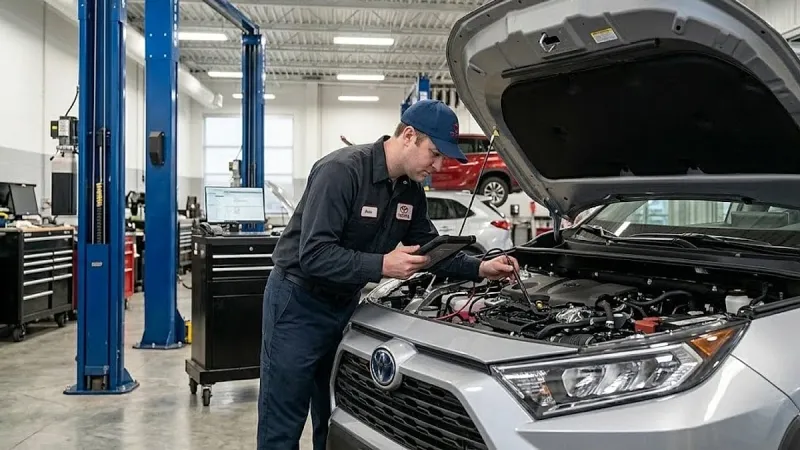
Photo: Toyota technician diagnostic inspection engine bay service center, via www.torquenews.com
There is a frustration familiar to nearly every American Toyota owner: you bring your vehicle in with a specific complaint, leave with a replaced part, and return two weeks later with the same problem. The symptom was addressed. The cause was not. What you experienced is the difference between reactive service and systematic diagnosis — and it is a gap that Toyota technicians at Pusat Toyota Bekasi have spent years learning to close.
The conditions that shaped their approach are worth understanding. Bekasi, a dense industrial city on the eastern edge of Jakarta, subjects its vehicles to a combination of stressors that would challenge even the most conservative maintenance schedule. High ambient humidity, stop-and-go traffic that rarely lets an engine fully warm up, road surfaces that alternate between smooth toll roads and pothole-riddled side streets, and fuel quality that varies meaningfully from one station to the next — these are not occasional challenges. They are daily operating conditions. To survive in this environment professionally, a Toyota technician must develop the habit of asking not just what failed, but why it failed, and what else the failure pattern reveals.
That habit, refined over years, has produced a diagnostic culture worth examining closely.
The Root-Cause Reflex
In many American service environments, diagnostic time is compressed. Flat-rate labor structures reward speed, and when a scan tool surfaces a fault code, there is institutional pressure to replace the flagged component and close the ticket. The logic is understandable: most of the time, it works. But when it does not work — when the code returns, or when a new symptom appears shortly after the repair — the root cause was likely upstream of the part that was replaced.
Bekasi technicians operate under a different default assumption. Because tropical conditions can generate misleading sensor readings — humidity infiltrating electrical connectors, heat cycling causing intermittent faults that do not appear consistently — a fault code is treated as the beginning of a diagnostic conversation, not the conclusion of one. The code tells you where the system reported distress. It does not always tell you what caused that distress.
This distinction shapes the entire service interaction. Before a repair order is written, a thorough technician in Bekasi will typically review the vehicle's service history, ask the owner about driving patterns and fuel sources, and conduct a physical inspection of components adjacent to the reported fault. The goal is to construct a narrative of the failure before committing to a solution.
Pattern Recognition Across a High-Volume Fleet
One structural advantage that Bekasi's Toyota service centers hold is volume. Pusat Toyota Bekasi services a large and consistent local fleet, which means technicians see the same models, the same failure modes, and the same environmental stressors repeatedly. Over time, this repetition builds a form of institutional pattern recognition that is difficult to replicate in lower-volume shops.
A technician who has seen forty Kijang Innovas present with rough idle symptoms under high-humidity conditions develops a mental index of which components fail in sequence, which fixes hold, and which apparent solutions are merely temporary relief. When the forty-first vehicle arrives, the diagnostic path is faster and more accurate — not because shortcuts are taken, but because the relevant variables have already been isolated through prior experience.
American Toyota owners can benefit from this indirectly. Toyota's global technical service bulletin network means that failure patterns identified in high-volume markets like Indonesia often inform service guidance distributed worldwide. When your dealership references a TSB for an unusual fault, there is a reasonable chance that the underlying pattern was first observed and documented in a market like Bekasi.
The Fuel Quality Variable Americans Rarely Consider
One diagnostic variable that Bekasi technicians routinely factor in — and that American technicians rarely need to consider — is fuel quality. Indonesia's retail fuel supply has historically included a range of octane grades and additive formulations, and the variation matters for engine management systems calibrated to specific combustion parameters.
While American fuel quality is generally more standardized, the lesson transfers in a different form. American Toyota owners who regularly use lower-octane fuel in vehicles specifying premium, or who fill up at stations with older underground storage that may introduce water contamination, are introducing a variable that can produce symptoms resembling sensor failures, injector faults, or ignition timing issues. Bekasi technicians are trained to ask about fuel sources as part of the intake process. It is a simple question that American service advisors rarely think to raise.
If you arrive at a service appointment and your technician does not ask about your fueling habits, you may want to raise the topic yourself.
Humidity as a Hidden Diagnostic Factor
Bekasi's humidity levels are substantial and persistent. For automotive electrical systems, prolonged humidity exposure creates specific and predictable failure patterns: connector corrosion that increases resistance without triggering obvious faults, moisture ingress into sensor housings that produces erratic readings, and insulation degradation that causes intermittent shorts under temperature cycling.
American drivers in coastal states, the Gulf South, or the Pacific Northwest are not immune to these dynamics. High-humidity environments from Houston to Miami to Seattle can produce the same failure modes, though often at a slower pace than Bekasi's climate demands. The diagnostic implication is the same regardless of geography: when an electrical fault is intermittent and does not reproduce consistently on a scan tool, the connector and harness condition deserves inspection before any sensor or module is replaced.
Bekasi technicians perform this inspection as a standard step. In American shops, it is sometimes skipped in the interest of time.
What American Toyota Owners Can Do With This Knowledge
Understanding the Bekasi diagnostic philosophy does not require a trip to Indonesia. It requires a shift in how you approach the service conversation at your local dealership or independent shop.
First, document your symptoms in detail before your appointment. Note when the symptom occurs, under what driving conditions, and whether it is consistent or intermittent. This information helps any technician build the narrative that root-cause diagnosis depends on.
Second, ask explicitly whether the proposed repair addresses the cause or the symptom. A good technician will be able to explain the causal chain. If the answer is vague, push for clarity.
Third, request that adjacent components be inspected when a fault is found. If a sensor is flagged, ask whether the wiring harness and connector serving that sensor have been visually inspected. In many cases, the answer to that question determines whether the repair holds.
Finally, consider the value of a dealership with high service volume and technicians who see your specific model regularly. Pattern recognition is a real and measurable advantage in diagnostic accuracy.
A Standard Worth Borrowing
The diagnostic discipline that Pusat Toyota Bekasi has developed was not designed with the American market in mind. It was built to solve real problems in a demanding environment, and it works. The principles behind it — prioritize root cause, factor in environmental variables, leverage pattern recognition, and inspect beyond the flagged component — are not proprietary to Bekasi. They are simply good practice.
American Toyota owners who understand this approach are better equipped to advocate for the quality of service their vehicles deserve. The first visit should produce the right answer. In Bekasi, that standard is expected. There is no reason it cannot be expected elsewhere.