What a $29 Oil Change Actually Costs: Engine Sludge Lessons From Bekasi's Humidity-Hardened Toyota Fleet
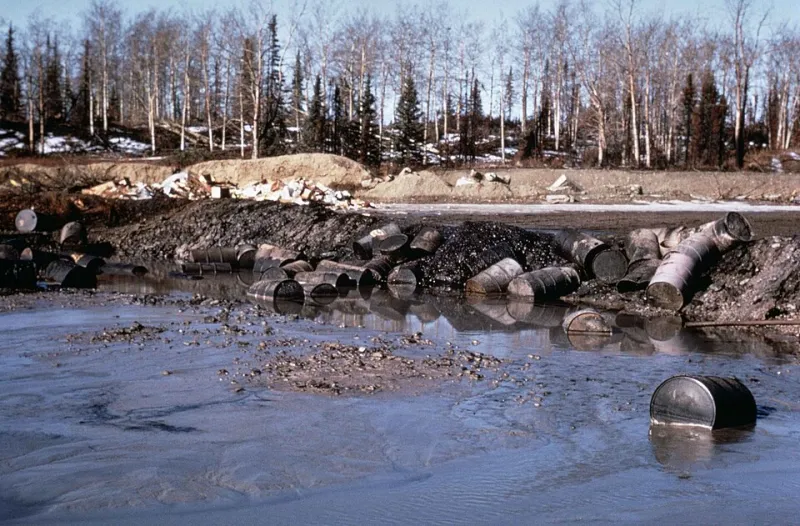
Photo: Goldman Luther C, U.S. Fish and Wildlife Service, Public domain, via Wikimedia Commons
There is a strip mall near most American suburbs with a quick-lube shop advertising oil changes for under thirty dollars. Millions of Toyota owners visit places like this every few months, consider their maintenance obligation fulfilled, and drive away without a second thought. It is one of the most routine acts in American car ownership.
It is also, according to the service history data we have accumulated at Pusat Toyota Bekasi, one of the most financially dangerous habits a Toyota owner can develop.
That claim requires some explanation — and the explanation begins not in the United States, but in the equatorial humidity of Bekasi, Indonesia.
Why Bekasi Became an Accidental Laboratory
Bekasi sits in a climate band where relative humidity rarely drops below 75 percent and frequently exceeds 90 percent during the rainy season. Temperatures hold between 28 and 34 degrees Celsius year-round. For automotive engineers, this environment functions as an accelerant — every corrosive process, every chemical degradation, every mechanical wear pattern that would take years to manifest in a temperate climate appears here in months.
For the technicians at Pusat Toyota Bekasi, this means we see the long-term consequences of maintenance decisions very quickly. A vehicle that receives inconsistent oil change intervals, or that is serviced with conventional mineral oil rather than full synthetic, does not hide its damage for years. It reveals the consequences within a single service cycle.
What we have documented in Bekasi's humid conditions maps directly onto what eventually happens to vehicles in the United States — it simply happens there on a slower timeline that makes the cause-and-effect relationship harder to recognize.
The Sludge Problem No One Talks About Plainly
Engine sludge is the thickened, semi-solid residue that forms when motor oil degrades past its effective service life. It accumulates in oil passages, coats the valve train, and progressively restricts oil flow to components that depend on constant lubrication. In severe cases, it blocks the oil pickup screen entirely, causing catastrophic engine failure within minutes of startup.
In moderate cases — the ones that do not end dramatically — it simply accelerates wear on every moving part the contaminated oil touches. Bearing surfaces, camshafts, timing chain tensioners, and piston rings all experience elevated friction. The engine does not fail immediately. It just ages faster, loses efficiency gradually, and eventually requires repairs that dwarf the cost of the premium oil changes that would have prevented them.
Humidity accelerates sludge formation in a specific way. Moisture enters the engine through the PCV system and through the normal thermal cycling of a parked vehicle. In high-humidity environments, the volume of moisture that condenses inside the crankcase is substantially higher. This water mixes with combustion byproducts and partially oxidized oil to form the acidic precursors of sludge. In Bekasi, we see this process complete itself in vehicles that are only slightly overdue on their oil change intervals. The margin for error is narrow.
In the American Midwest or Southeast — regions with genuine humidity — the same chemistry is operating. It is slower, but it is present.
Conventional Oil Versus Synthetic: The Case Studies
Over several years of service records at Pusat Toyota Bekasi, a consistent pattern has emerged when comparing vehicles serviced with conventional mineral oil against those maintained exclusively with full synthetic lubricants.
Vehicles using conventional oil at standard intervals showed measurable sludge accumulation in the valve cover area by approximately 60,000 to 80,000 kilometers under Bekasi's conditions. Vehicles using full synthetic oil at the same intervals showed minimal accumulation at the same mileage. The difference was not subtle — it was visible during routine valve cover inspections.
More significantly, the vehicles with sludge accumulation required corrective services — valve train cleaning, oil passage flushing, and in several cases, partial engine disassembly — that averaged between 4,500,000 and 7,000,000 Indonesian Rupiah in labor and parts. Converted to approximate US dollar equivalents, that range falls between $280 and $440 per corrective event, not counting any component replacement.
The cumulative cost of switching every oil change to a quality full synthetic — roughly an additional $30 to $50 per service depending on the shop and the specific product — is recovered completely after avoiding a single corrective service. The vehicle that never needs sludge remediation simply costs less to own over its lifetime, with the savings compounding across every subsequent year of service.
The Interval Problem Is Separate From the Oil Quality Problem
American Toyota owners often assume that using synthetic oil at standard intervals resolves the lubrication question entirely. Synthetic oil is more resistant to thermal degradation and oxidation than conventional oil, and it does provide meaningfully better protection. But interval length and oil quality are two distinct variables, and addressing only one of them leaves the other unmanaged.
Toyota's standard oil change recommendation for many models is 5,000 miles under severe service conditions and up to 10,000 miles under normal conditions with synthetic oil. The "severe service" definition in the owner's manual includes conditions that apply to a significant portion of American drivers: frequent short trips under five miles, towing or hauling, extensive idling, and operation in dusty or high-humidity environments.
Drivers in Houston, Miami, New Orleans, or anywhere in the humid southeastern United States are operating under severe service conditions by Toyota's own definition. Using the normal-condition interval in these environments means the oil is in service longer than Toyota's engineering assumptions account for under those specific operating stresses.
Bekasi's data suggests the practical recommendation is straightforward: use full synthetic oil rated to Toyota's specifications, and observe the severe-service interval if any of the qualifying conditions apply to your driving pattern. The cost difference over a year is modest. The difference in engine condition at 150,000 miles is not.
Calculating the Real Numbers
Consider a Toyota Camry owner in Atlanta, Georgia — a city with genuine humidity and a driving pattern that includes frequent short commutes. This driver visits a discount quick-lube every 7,500 miles using conventional oil at $29 per service.
Over 150,000 miles, that represents approximately 20 oil changes at a total cost of $580.
The same owner using full synthetic at a Toyota-authorized dealer, at a severe-service interval of 5,000 miles, completes 30 oil changes at roughly $75 each — a total of $2,250.
The difference is $1,670 over the vehicle's first 150,000 miles. That figure looks unfavorable to the premium option until a single sludge remediation service, a timing chain tensioner replacement accelerated by contaminated oil, or a valve train cleaning is added to the conventional-oil scenario. Any one of those events erases the savings and moves the math firmly in favor of the proactive approach.
What Bekasi Teaches About the Long Game
At Pusat Toyota Bekasi, we operate in conditions that compress automotive time. The damage that takes a decade to appear in a temperate American climate appears here in two or three years. That compression gives our technicians a clarity about cause and effect that is genuinely difficult to develop in environments where the consequences arrive slowly.
The lesson from Bekasi's service records is not complicated: the cheapest oil change is the one that prevents the expensive repair. Premium synthetic lubrication and honest interval discipline are not upsells — they are the foundational maintenance decisions that determine what a Toyota costs to own over its full service life.
The $29 oil change is not a bargain. It is a deferred payment on a much larger invoice.